
Toad® for IBM DB2
Beta Version 5.6.0.2904
Beta Release Notes
April 4, 2014
Contents
Welcome to Toad for DB2
Toad for DB2 is a database
development and administration solution that provides productivity features for
rapidly creating and executing queries, automating database object management,
developing SQL code, and instant access to DB2 expertise.
Developers and administrators
have access to a community of users, peers, and experts to help solve
development and administration issues and assist in developing applications and
feedback for improving Quests products.
All of this comes with the
backing of Quest Software, a healthy and growing corporate entity that can
provide the necessary training, support, and superior customer service demanded
by IT management.
New in This Release
The
latest Toad for DB2 5.6 Beta drop includes fixes and new enhancements.
Additional new features, enhancements and fixes will be introduced throughout the
Beta cycle.
- For a description of customer
issues resolved in this release, see Resolved
Issues and Enhancements.
Features
and Updates in Toad for DB2 5.6
Database Administration
DB2 on
z/OS
In this release, Toad introduces support for new features
introduced in DB2 z/OS v11.1
Toad has been updated to support Compatibility mode and ENF mode
for DB2 z/OS V11.1.
Toad has been enhanced to support the new DB2 Utility Statement
syntax introduced in IBM DB2 z/OS V11.1.
The utility editors for LOAD, UNLOAD, REBUILD INDEX, REPAIR, REORG
TABLESPACE, REORG INDEX, RUNSTATS have been enhanced to support the new
syntax.
The screen-shot of the Rebuild Index dialog below highlights
several new utility statement parameters:

Toad supports the new DB2 Archive table feature.
Toad now displays tables and archive tables in the Database
browser. Archive tables are identified
with a unique icon as shown below:

To define an archive table for a given table, alter the base table
as shown below:

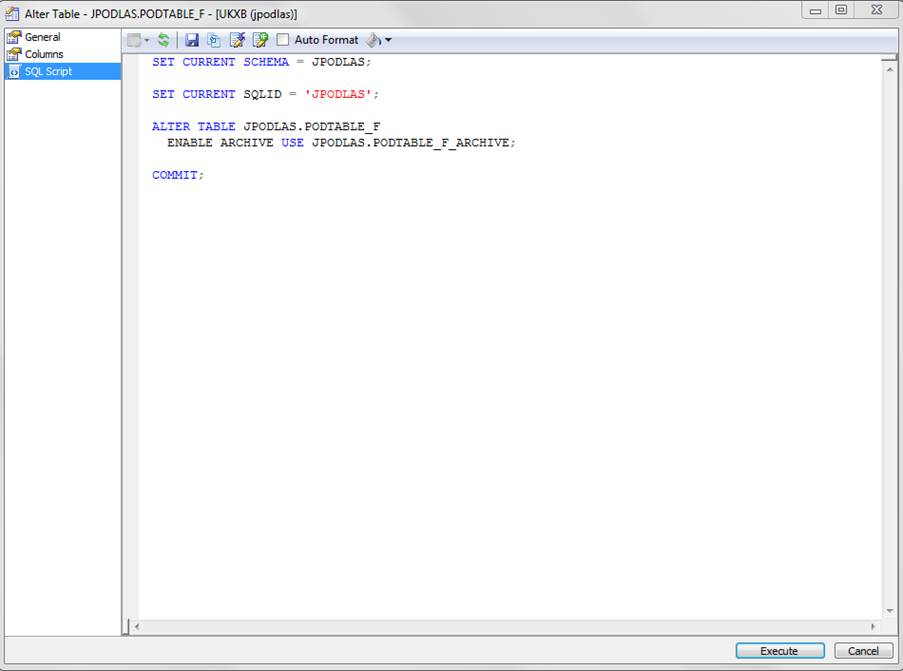
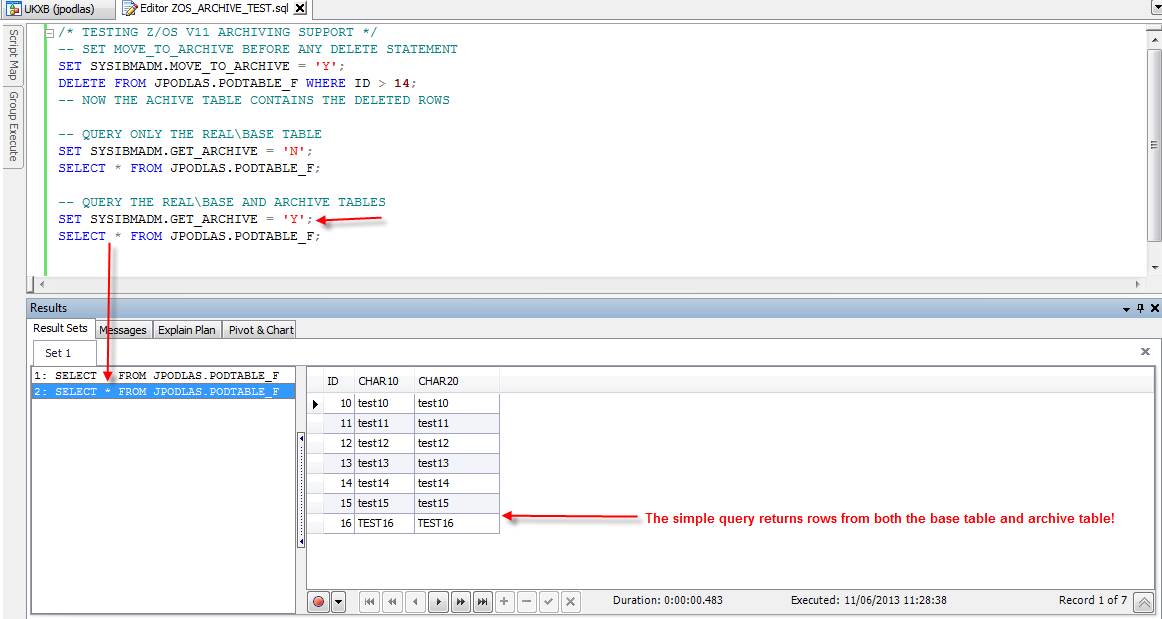
Once archiving has been enabled
for your tables, you can use the IBM DB2 built-in registry values within the
Toad SQL editor to get the full benefits for archive table support.
See the below script for an
example:
Toad now includes support for
Array Types in DB2 on z/OS. You can now
view Array Types on the Datatypes tab in the database
explorer.
You can now also manage Array Types via the right-click menu actions as shown
below..

The Create\Alter dialog makes managing
array types easy.

Toad has added support for the Alter Table..Drop Column clause.
Now when you remove a column from a DB2 z/OS table in the alter table
dialog, the appropriate ALTER TABLE…DROP COLUMN statement is generated.

The ALTER TABLE…DROP COLUMN
generated script:

In this release we have modified
and enhanced our RUNSTATS utility dialog.
You can now specify the Profile clause as shown below.

Also, we enhanced the RUNSTATS
and other utility Dialogs to make it easier to specify STATISTICS parameters
for all indexes.
Checking the ‘Use for all Indexes’ checkbox shown below will apply the
right-hand side index statistics clause to all indexes:

Sample Generated Script (when the
‘Use for all Indexes” checkbox is checked:

Toad also enhanced the LOAD and
REORG utility dialogs to make it easy to specify Table and Index STATISTICS
clauses on those utilities as well:


DB2 on
Linux, UNIX and Windows (LUW)
In this release, Toad continues our support of features in DB2 LUW
v10.5.
When an LUW database is selected in the Database Explorer, there
is now a new ‘Members’ right-hand-side tab that will display pureScale member information or DFP member information (if
not in a pureScale environment). An example screen-shot is shown below:

Toad had added support for Index Key Expressions. To specify a Key
Expression, use the below buttons on the Dialog when you are creating or
altering an index.

The generated scripts will contain the key expression syntax, for
example like:

Toad also has implemented support for the INCLUDE/EXCLUDE NULLS
KEYS clause on indexes.
This can be specified when creating or altering indexes as shown
below:

The INCLUDE
NULL KEYS clause in a generated script:

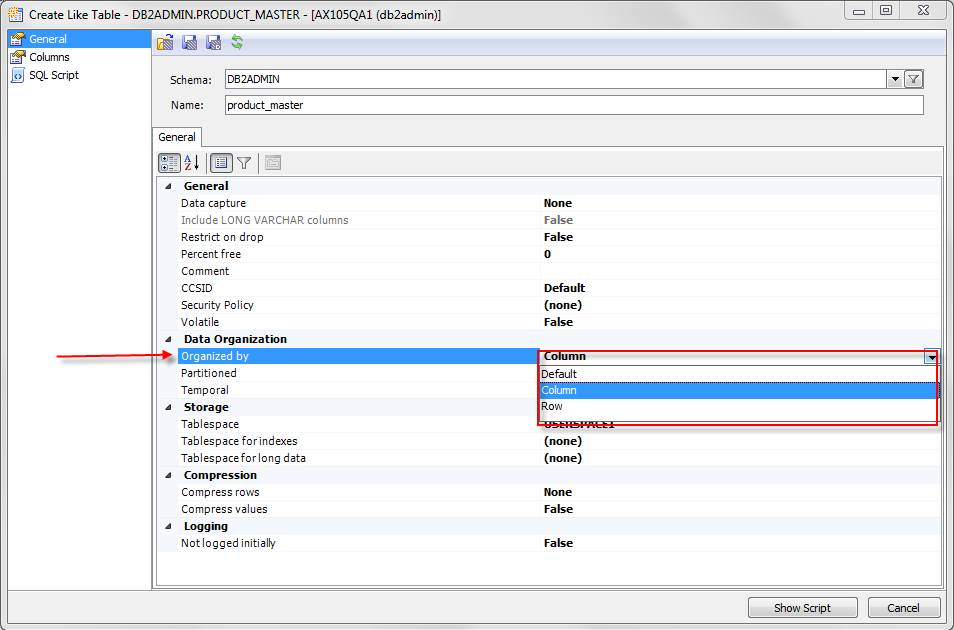
Toad now has support for the ORGANIZE BY COLUMN\ROW clauses for
Tables. That can be specified while
creating or altering a table as shown below:
Common
DB2 features (apply to both DB2 LUW and DB2 z/OS)
Toad has an updated Table
Editor where now it is easier to specify columns. When you are creating a table and select the
columns tab, now a new column is added automatically by default. And you may now use keyboard shortcuts to add
a column (Ctrl+a), remove a column (del), move a column up (Ctrl+up)
or down (Ctrl+down):

Also, to simplify things, you
can now specify the column type using the drop down list box in the top control
and when adding a new column the cursor is positioned in the Name control:

General Features
Toad now allows you to select DB2 specific Timestamp formats such
as JIS, USA, EUR and ISO for Timestamp displays in grid controls.

Resolved Issues and Enhancements
Resolved Issues and Enhancements in
Toad for DB2 5.6 Beta
The
following is a list of issues addressed and enhancements implemented in the
current release:
|
Feature |
Resolved Issue |
Support case\Defect-Enhancement ID |
Drop |
|
Import Wizard |
Import issues when TIMEZONE set to UTC+1
|
2410535-1\TDB-626 |
5.6.0.2904 |
|
Reorg Table LUW |
REORG statement syntax on Column Organized Table only supports RECLAIM EXTENTS and Toad allows other clauses
|
TDB-526 |
5.6.0.2831 |
|
Alter User |
Excessive quoting of User name in Alter User editor
|
2395731-1\TDB-558 |
5.6.0.2831 |
|
Table Alter |
Can only set IDENTITY colunn start with value to 1
|
2403661-1\TDB-565 |
5.6.0.2831 |
|
Dataset Templates |
Cannot change the Retention Period in the Dataset Template editor
|
2407047-1\TDB-570 |
5.6.0.2831 |
|
Table Alter |
Extended Alter on z/OS Table with RI does not generate CHECK DATA on Child table
|
2328053-1\TDB-422 |
5.6.0.2699 |
|
Migrate Data |
Incorrect parameters were generated on the REPLACE and RESUME clauses
|
2380420-1\TDB-429 |
5.6.0.2699 |
|
z/OS Runstats |
Now all tables and indexes are selected when you invoke the RUNSTATS dialog and you can now easily specify parameters for all indexes
|
2376277-1\TDB-431 |
5.6.0.2699 |
|
Table Editor |
Toad not has better Hints on the buttons on the Table Editor - Columns tab to make to easier to understand the buttons actions
|
2376288-1\TDB-488 |
5.6.0.2699 |
|
Migrate Object |
Using “Select
All” for Data checkboxes yields “Object reference not set to an instance of
an object"
|
2364624-1\TDB-317 |
5.6.0.2662 |
|
Table Alter |
Adding columns
to a Table with views will generate a DROP/CREATE script instead of ALTER
TABLE…ADD COLUMN
|
TDB-371 |
5.6.0.2662 |
|
Toad Version Display |
The Toad for
DB2 version is incorrectly displayed in the Windows Control Panel\Programs
and Features section
|
TDB-238 |
5.6.0.2662 |
|
QCEXEC |
In the z/OS
Batch Execution program: SQL Code -206 was issued determining the DECIMAL
delimiter
|
2348167-1\TDB-258 |
5.6.0.2567 |
|
Object Compare |
The Object
Compare Report was missing the Object Details and Comparison Results
|
2339544-1\TDB-254 |
5.6.0.2567 |
|
Tablespace Reorg |
Keywords are
missing in the STATISTICS clause when multiple Tablespaces
are selected for REORG
|
2348488-1\TDB-246 |
5.6.0.2567 |
|
Alter STOGROUP |
When volumes
are added\removed during an ALTER Storage Group on z/OS, error messages are
generated
|
2346467-1\TDB-245 |
5.6.0.2567 |
|
Data Grid |
The Data Grid
basic filter – value chooser sorts date values incorrectly as character
strings
|
2246560-1\TDB-234,
TDB-48 |
5.6.0.2567 |
|
Script Generation |
Toad losed dependent view permissions when altering a table
|
TDB-226 |
5.6.0.2567 |
|
z/OS Utility Statements for DB2 V11.1 |
Toad needs to
support the new utility syntax introduced in DB2 z/OS V11.1
|
TDB-265
– TDB-271 |
5.6.0.2567 |
|
Export Wizard |
Export Wizard
– when the target is ‘Create as new table’ – support is needed for all
encoding schemes: ASCII, EBCDIC, Unicode
|
TDB-213 |
5.6.0.2567 |
|
Space Calculator |
Tablespace Utilization would show
incorrect values on LUW databases that are partitioned
|
2249111-1\2248073-1\TDB-34 |
5.6.0.2525 |
|
Alter Server |
Alter Server
could generate a DROP and CREATE instead of a native ALTER
|
TDB-65 |
5.6.0.2525 |
|
Explain Plan |
Executing an
explain plan while a query is running can freeze Toad’s interface
|
TDB-239 |
5.6.0.2525 |
|
Stored Procedures |
Code
completion was incorrectly including the direction parameter types (IN\OUT)
on call procedure statements generated in the SQL Editor.
|
TDB-237 |
5.6.0.2525 |
|
Stored Procedures |
The Create
statements for complex stored procedures are now identified completely within
the SQL Editor.
|
23118937-1\TDB-197 |
5.6.0.2525 |
|
Space Usage |
You can now use
Ctrl+C to copy cells on the Tablespace
– Space Usage Tab
|
TDB-187 |
5.6.0.2525 |
|
User Permissions |
When adding
permissions on Procedures, users are able to specify a single Procedure more
than once
|
2265833-1\TDB-84 |
5.6.0.2451 |
|
Script Generation |
The script for
triggers may contain an incorrect REFERENCING clause
|
2326205-1\TDB-209 |
5.6.0.2451 |
|
SQL Editor |
Explain Plan
Tab: Hovering over Explain graphic shows name of object.object
in pop-up
|
2247684-1\TDB-56 |
5.6.0.2451 |
|
Histogram |
The SQL driven
within the Histogram feature should have “WITH UR” appended to avoid locks
|
TDB-188 |
5.6.0.2451 |
|
Dependencies Tab |
When
displaying Synonyms in the Dependency Tree, the Schema name was not being
displayed
|
2264172-1\TDB-70 |
5.6.0.2356 |
|
Extract DDL |
User defined
statement delimiter is not being used in the Extract DDL feature
|
2266062-1\TDB-76 |
5.6.0.2356 |
|
Right-click menu |
Invalid
right-click actions are displayed at times on objects in the database
browser, when trial license keys are used
|
ST111585\TDB-115 |
5.6.0.2356 |
|
Connection Profile |
Duplicate
connection profile generated when using Schema Compare
|
2090986-1\TDB-116 |
5.6.0.2356 |
|
Table Alter |
Incorrect
Script results when altering a table.
|
2301035-1\TDB-174 |
5.6.0.2356 |
|
Grid Control |
You may now
select DB2 Timestamp specific formats to format your DB2 timestamp data in
data grids.
|
TDB-191 |
5.6.0.2356 |
|
SQL Editor |
Code
completion on a CALL statement does not display correct procedure names in
all cases
|
TDB-63 |
5.6.0.2232 |
|
Object Compare |
Object Compare
will generate invalid SQL statement for DB2 LUW v9.5 AIX database
|
2254606-1\TDB-67 |
5.6.0.2232 |
|
Data Generator |
Data
Generation (z/OS): Exception appears when table has several constraints
|
1087470-1\TDB-114 |
5.6.0.2232 |
|
Data Migration |
Data Migration
fails due to un-matching Export\Import file names
|
2307331-1\TDB-178 |
5.6.0.2232 |
|
SQL Editor |
SQL Editor
"Show Explain Plan" button is not using updated SQL in the Editor
|
2279560-1\TDB-121 |
5.6.0.2107 |
|
Export Wizard |
Data Export
exports to incorrect table
|
2274089-1\TDB-118 |
5.6.0.2107 |
|
Export Wizard |
Exporting a
UNICODE source file to a new table gives error
|
2274107-1\TDB-88 |
5.6.0.2107 |
|
Script Generation |
z/OS Alter TS generates invalid
script
|
2268823-1
\TDB-87 |
5.6.0.2107 |
|
Utilities Tab |
Database
Utilities tab and other tabs once placed into the background continue to
refresh even after leaving the document
|
2267296-1
\TDB-86 |
5.6.0.2107 |
|
Database Connection Manager |
User can't
connect when NODE info is missing from an LDAP connection
|
2250914-1
\TDB-81 |
5.6.0.2107 |
|
Database Explorer |
Index columns
not showing in Database Explorer
|
2265817-1
\TDB-79 |
5.6.0.2107 |
|
Object Compare |
Exception
while using Advanced Common Options in Object Compare
|
2255552-1
\TDB-61 |
5.6.0.2107 |
|
Database Diagrammer |
Database Diagrammer does not show all Foreign Key relationships
when multiple relationships exist to a table
|
2250040-1
\TDB-62 |
5.6.0.2107 |
Known Issues
At this point in time, no additional known issues have been
reported since the GA of our v5.5 product.
Please reference the known issues of our GA release notes at Release
Notes GA – Known Issues.
Third-Party
Known Issues
|
Feature |
Known Issue |
Support case\Defect-Enhancement ID |
|
LUW Procedure Script Tab |
After
installing DB2 LUW v10.1.3, the script tab for LUW procedures is empty. This is due to an issue introduced by IBM
in fixpack 3 regarding the NULLIF SQL
function. IBM APAR IC96725 addresses
this issue.
|
2303729-1\TDB-180 |
|
DB2 z/OS invalid Timestamp values returned |
When the IBM
DB2 Analytics Accelerator is used in conjunction with DB2 z/OS, along with an
IBM DB2 .Net Data Provider v10.1.3, timestamp values returned from queries
are invalid. Since Toad DB2 v5.6 uses
the IBM DB2 v10.1.3 .Net Data provider, invalid timestamp values can be
returned within Toad v5.6. IBM PMR
8862756 has been opened on this topic.
Please consult that PMR for a work-around.
|
N\A |
At this point in time, no additional third party issues have been
reported since the GA of our v5.5 product.
Please reference the known issues of our GA release notes at Release
Notes GA – Third Party Issues.
Upgrade and
Compatibility
Upgrade Toad for DB2
Review upgrade information in
the Toad for DB2 Installation Guide available from the Windows Start menu
under Program Files | Quest Software | Toad for DB2 | Documentation.
This Toad for DB2 beta is a separate product that will not upgrade
any commercial Toad for DB2 products that you may have installed on your machine.
This beta can be installed on a machine that has other versions of
Toad DB2 installed. You
should install this beta into a separate, new directory.
For Toad DB2 on z/OS users, this beta will work with the Quest IBM
DB2 z/OS Components that you may have installed with Toad for DB2 v4.6, or
later, so there is no reason to install those z/OS Components again, if they
already exist.
System Requirements
Verify that your system meets the requirements described in the
following sections:
Client Requirements
Toad for DB2 client installation requires the following.
Note: If a DB2 for LUW 7 client is installed on the machine where
you are installing Toad, you must upgrade the DB2 client to version 8 before
installing Toad for DB2 to avoid losing functionality in some DB2 native tools.
|
Platform |
1 GHz minimum |
|
Hard Disk Space |
212 MB of disk space required to run Toad. Allocate the following additional space as needed:
|
|
Memory |
512 MB of RAM minimum, 1 GB recommended Note: The memory required may vary based on the following:
|
|
Supported Operating Systems |
Windows Server 2003 with SP2 or
later Windows Server 2003 R2 Windows XP Professional with SP3
(32-bit or 64-bit, except Starter Edition) Windows Vista with SP2 or later
(32-bit or 64-bit, except Starter Edition) Windows Server 2008 with SP2 or
later (32-bit or 64-bit) Windows Server 2008 R2 (64-bit) Windows 7 (32-bit or 64-bit) |
|
.NET Framework |
.NET Framework Microsoft
.NET Framework 3.5 (SP1) and 4.0 |
|
Database Client |
DB2 Client Toad installs a DB2 10.1.2 client
as part of the installation process. Requirements for 32-Bit and 64-Bit
Environments |
|
Additional Requirements |
Web Browser Microsoft Internet Explorer 7.0 or later |
Server Requirements
Toad supports any of these DB2 and operating system versions.
|
Database Server |
IBM
DB2 for LUW 9.1, 9.5, 9.7,
10.1, 10.5 Note: Toad
may support IBM DB2 Express and SWE in addition to listed above servers, but
note that no testing was performed on it. |
|
Supported Operating Systems for Toad for DB2 Agent |
Toad for IBM DB2 requires that the
Toad for IBM DB2 for DB2 Agent reside on each DB2 for LUW server on which you
intend to execute scripts server-side (using the Toad for IBM DB2 LUW Remote
Script Execution feature). The agent supports servers running
in any of these operating systems:
Note: The following additional requirements
apply:
See the Toad for IBM DB2 for
DB2 LUW Agent Installation Guide for complete agent requirements and
installation details. |
|
Hard Disk Space for Toad for DB2 Agent |
For
the Toad for IBM DB2 LUW Remote Script Execution component, 34.9 MB |
|
Application Virtualization |
Limited testing has been performed
for Citrix XenApp 5.0 on Windows Server 2003 and
Citrix XenApp 6.5 on Windows Server 2008 R2. Limited testing has been performed
for Citrix support on Windows Server 2003 Enterprise Server (Service Pack 2)
using the MetaFrame Presentation Server 5.0 and
Citrix Presentation Server Clients 10.2. |
|
Desktop
Virtualization (VDI) |
Toad has been tested with Quest vWorkspace 7.6 running on Windows Server 2008 R2 64-bit. |
User Privilege Requirements
User Requirements to Install Toad
Only
Windows Administrators and Power Users can install Toad.
Note: The following
exceptions exist for Power Users:
- A Power
User cannot install Toad on a computer running Windows Vista Enterprise.
This is a Windows limitation because Vista does not support Power User
mode.
- A Power User
can install Toad for IBM DB2 as long as this user belongs to the DB2ADMNS
or DBUSERS group.
If
an Administrator installs Toad, the Administrator can share the Toad shortcut
icon on the desktop and menu items with any user—a Power User, Restricted User,
Vista standard user—on the computer.
If a Power User installs Toad, a
Restricted User cannot do the following:
- Associate file extensions.
- View the Toad shortcut icon on
the desktop or the Toad menu options in the Windows Start menu. As a
workaround, Restricted Users can create a shortcut to Toad from the
install directory and place the shortcut on their desktop.
User Requirements
and Restrictions for Running Toad
The
following describes the requirements and restrictions for users who launch and
run Toad:
- A Windows Power
User or Restricted User must belong to the DB2ADMNS or DB2USERS group. To
add the user to one of these groups, select Start | Control Panel | Administrative Tools
| Computer Management | System Tools | Local Users and Groups | Groups |
DB2ADMNS or DB2USERS.
·
A
Windows Vista user must be either an administrator or a standard user that
belongs to an Vista Administrators group.
Additionally, to enable full functionality in Toad for IBM DB2 when Vista’s
User Access Control security feature is turned on, the standard user must run
Toad for IBM DB2 as an administrator. (Right-click the Toad for IBM DB2 icon on
the Vista desktop and select Run as
administrator.)
- A Windows Power
User or Restricted User does not have the authority to add or remove DB2
catalog entries using the Toad for IBM DB2 Client Configuration wizard.
However, these users can use the Import Profile function in the Toad for
IBM DB2 Client Configuration wizard to import catalog entries to Toad for
IBM DB2.
·
To
take full advantage of Toad for DB2 LUW functionality, the user ID specified in
the Toad connection profile for each DB2 for LUW database connection requires
the authorizations listed in the following document:
·
As
a minimum requirement to manage a DB2 for z/OS subsystem in Toad for IBM DB2,
the user ID defined in the Toad for IBM DB2 connection profile for the subsystem
must either have SYSADM privileges or SELECT privileges on the DB2 catalog
tables. For a complete list of authorizations (and corresponding GRANT
statements) a user requires to take full advantage of Toad for DB2 z/OS
functionality, refer to the following document:
- To create or modify the QuestSoftware.ToadSecurity table to enable Toad
Security, the user who maintains this table must have privileges to
create, insert, update, and delete it. All other users need only the
ability to read the QuestSoftware.ToadSecurity
table to use Toad Security features.
- For information about defining a RACF,
Unix, or Linux group as a Toad Security role, see
the About Setting Up Toad Security
topic in the Toad online help. This topic explains how to add the Toad
Security icons to your toolbar and how to define Toad Security roles that
apply to your current connection. (The ability to define RACF, Unix, and
Linux groups as Toad Security roles works with DB2 for LUW 9 or later
databases and DB2 for z/OS 8 or later subsystems.)
Requirements for
Full Access to Toad for IBM DB2 for DB2 z/OS Functionality
Install
the following components on each DB2 for z/OS subsystem:
·
Quest
IBM DB2 z/OS component
Notes:
o
Without the z/OS component installed, Toad for IBM DB2 provides
limited support for managing DB2 for z/OS subsystems. With the z/OS component
installed, you have access to a full range of Toad for IBM DB2 functionality
needed to manage DB2 subsystems.
- If no Quest IBM DB2 z/OS component is installed
on your subsystem, see the Quest IBM DB2
z/OS Installation Guide for installation requirements and
instructions.
·
IBM
stored procedure SYSPROC.DSNUTILU, installed and operational.
Notes:
- A 32K character-size limit exists for each
utility statement executing through DSNUTILU.
- Certain table alterations
require that Toad perform advanced alters involving multiple UNLOADs and
LOADs of table data. Before executing these types of alterations, ensure
that the Mask value defined for the
Toad dataset template that generates the Unload datasets includes the &SEQ variable. This variable creates a unique
name for each Unload dataset. (The Unload dataset template is identified
in Tools | Options | Database | DB2 |
z/OS | Load/Unload.)
- When Toad migrates
data from one subsystem to another, Toad invokes the IBM DB2 for z/OS
UNLOAD and LOAD utilities. Ensure that the Reorg Unload dataset template
(identified in Tools | Options | Database
| DB2 | z/OS | Reorg) generates a dataset that resides on a pack
(VOLSER) accessible by both the source and target subsystem.
Recommended Indexes to Improve Toad
Performance in DB2 for z/OS
User-defined indexes
on specific system catalog tables can improve performance when you are browsing
DB2 for z/OS objects in Toad. The following link contains the DDL for indexes
that can optimize Toad performance on your DB2 for z/OS subsystem. Keep in mind
that the creation of these indexes is a recommendation only. The indexes can
have different results in different environments, depending on the number of
DB2 objects and the amount of data involved. To create these indexes, edit and
run the DDL contained in the following file:
Additionally, if the
schema drop-down lists in the Object Migration wizard populate slowly, consider
creating an index on the SCHEMA and CREATOR columns in the catalog table for
each object type. Here is a list of some of the object-type tables:
SYSIBM.SYSSYNONYMS
SYSIBM.SYSSEQUENCES
SYSIBM.SYSROUTINES
SYSIBM.SYSTABLES
SYSIBM.SYSDATATYPES
SYSIBM.SYSINDEXES
SYSIBM.SYSTRIGGERS
SYSIBM.INDEXES
Recommended Indexes to Improve Toad Performance in DB2 for z/OS
User-defined indexes on specific system catalog tables can improve
performance when you are browsing DB2 for z/OS objects in Toad. The following
link contains the DDL for indexes that can optimize Toad performance on your
DB2 for z/OS subsystem. Keep in mind that the creation of these indexes is a
recommendation only. The indexes can have different results in different
environments, depending on the number of DB2 objects and the amount of data
involved. To create these indexes, edit and run the DDL contained in the
following file:
http://www.toadsoft.com/toaddb2/ReleaseNotes/Latest/ToadDB2zOSIndexes.txt
Additionally, if the schema drop-down lists in the Object
Migration wizard populate slowly, consider creating an index on the SCHEMA and
CREATOR columns in the catalog table for each object type. Here is a list of
some of the object-type tables:
SYSIBM.SYSSYNONYMS
SYSIBM.SYSSEQUENCES
SYSIBM.SYSROUTINES
SYSIBM.SYSTABLES
SYSIBM.SYSDATATYPES
SYSIBM.SYSINDEXES
SYSIBM.SYSTRIGGERS
SYSIBM.INDEXES
Global Operations
This section contains information about
installing and operating this product in non-English configurations, such as
those needed by customers outside of North America. This section does not
replace the materials about supported platforms and configurations found
elsewhere in the product documentation.
This release is Unicode-enabled and
supports any character set. It supports simultaneous operation with
multilingual data. This release is targeted to support operations in the
following regions: North America, Western Europe and Latin America, Central and
Eastern Europe, Far-East Asia, Japan.
This release has the following known
capabilities or limitations:
* * During the Toad for IBM DB2
installation process, if the user overrides the default installation path, the
new path specification cannot contain Unicode characters. This limitation
exists because Toad installs a IBM DB2 for LUW client
in the specified Toad installation path, and IBM DB2 installations do not
support Unicode characters.
** (This limitation applies ONLY to
the Xpert edition of Toad for IBM DB2 for z/OS and to
the DBA edition of Toad for IBM DB2 for LUW). Quest SQL Tuning for IBM DB2 z/OS
and Toad Remote Script Execution (for IBM DB2 LUW or z/OS) supports
single-byte character sets only. These features do not support double-byte or
multi-byte character sets. All IBM DB2 client and server installations should
be configured to use the same or compatible character encodings and the same
locale and regional options.
Getting Started
The Toad
release package contains the following products:
The Toad release package contains
the following products:
·
Toad
for IBM DB2 5.6
·
Quest
IBM DB2 z/OS Component
·
Product
Documentation, including:
o
Toad
for IBM DB2 Installation Guide
o
Quest
IBM DB2 z/OS Component Installation Guide
o
Toad
for IBM DB2 LUW Agent Installation Guide
Toad for
IBM DB2 Installation Instructions
For More Information
|
|
|
|
|
Quest Software, Inc. |
|
Web |
Refer to our Web site for regional and international office
information.
Contacting Quest Support
Quest
Support is available to customers who have a trial version of a Quest product or
who have purchased a Quest product and have a valid maintenance contract. Quest
Support provides unlimited 24x7 access to SupportLink, our self-service portal. Visit SupportLink at http://support.quest.com.
From
SupportLink, you can do the following:
- Retrieve thousands of solutions
from our online Knowledgebase
- Download the latest releases
and service packs
- Create, update and review
Support cases
View
the Global Support Guide for a detailed explanation of support programs, online
services, contact information, policies and procedures. The guide is available
at: http://support.quest.com.
This guide is available in English only.
© 2013 Quest Software, Inc.
ALL RIGHTS RESERVED.
This
guide contains proprietary information protected by copyright. The software
described in this guide is furnished under a software license or nondisclosure
agreement. This software may be used or copied only in accordance with the
terms of the applicable agreement. No part of this guide may be reproduced or
transmitted in any form or by any means, electronic or mechanical, including
photocopying and recording for any purpose other than the purchaser’s personal
use without the written permission of Quest Software, Inc.
The
information in this document is provided in connection with Quest products. No
license, express or implied, by estoppel or otherwise, to any intellectual
property right is granted by this document or in connection with the sale of
Quest products. EXCEPT AS SET FORTH IN QUEST'S TERMS AND CONDITIONS AS
SPECIFIED IN THE LICENSE AGREEMENT FOR THIS PRODUCT, QUEST ASSUMES NO LIABILITY
WHATSOEVER AND DISCLAIMS ANY EXPRESS, IMPLIED OR STATUTORY WARRANTY RELATING TO
ITS PRODUCTS INCLUDING, BUT NOT LIMITED TO, THE IMPLIED WARRANTY OF
MERCHANTABILITY, FITNESS FOR A PARTICULAR PURPOSE, OR NON-INFRINGEMENT. IN NO
EVENT SHALL QUEST BE LIABLE FOR ANY DIRECT, INDIRECT, CONSEQUENTIAL, PUNITIVE,
SPECIAL OR INCIDENTAL DAMAGES (INCLUDING, WITHOUT LIMITATION, DAMAGES FOR LOSS
OF PROFITS, BUSINESS INTERRUPTION OR LOSS OF INFORMATION) ARISING OUT OF THE
USE OR INABILITY TO USE THIS DOCUMENT, EVEN IF QUEST HAS BEEN ADVISED OF THE
POSSIBILITY OF SUCH DAMAGES. Quest makes no representations or warranties with
respect to the accuracy or completeness of the contents of this document and
reserves the right to make changes to specifications and product descriptions
at any time without notice. Quest does not make any commitment to update the
information contained in this document.
If
you have any questions regarding your potential use of this material, contact:
|
Quest Software World
Headquarters Email: legal@quest.com
|
Refer to our web site (www.quest.com)
for regional and international office information.
Trademarks
Quest,
Quest Software, the Quest Software logo, Toad, T.O.A.D., and Toad World are
trademarks and registered trademarks of Quest Software, Inc
in the United States of America and other countries. For a complete list
of Quest Software’s trademarks, please see http://www.quest.com/legal/trademark-information.aspx
. Other trademarks and registered trademarks are property of their respective
owners.